The Data Science Interview Playbook
Patterns from 80+ interview rounds and 5 offers, Spring 2026. Every round in the loop: case studies, coding, applied ML, statistics, project deep dives, and behavioral. Written for candidates who are already getting the interviews. (Not getting interviews yet? Start with these free resources instead.)
Outside the US, or targeting a more junior role? Please do get in touch and I will send you a code.
Written, roughly 120 pages, including the 80-minute Master the Case Study video series as a standalone chapter.
In 2026: senior data scientist at Google, Uber, and Meta; staff at Figma and Attentive. I withdrew from four further final rounds.
Mid-level through senior staff, across more than 100 mock interviews. Neither list is exhaustive.
I took 80+ interview rounds in five weeks and started seeing patterns everywhere
In April and May of 2026, I interviewed at Google, Uber, DoorDash, Meta, Figma, Netflix, Adobe, Coupang, Shopify, Attentive, Haus, Zocdoc, Roblox, Upstart, Brex, and Chime. By the second week, I was recognizing questions I had already been asked somewhere else.
Companies were not asking identical questions, but they kept circling the same ground. Statistical foundations resting on hypothesis testing and conditional probability. Past project deep dives and behavioral questions that rewarded the same underlying structure every time. Marketplace product cases carrying the same traps: the metric that looks obvious and quietly misleads, and the population that loses from a change nobody thought to check on. Different companies, different interviewers, the same small set of things being tested.
I converted 5 offers from 8 final rounds: senior data scientist at Uber, Google, and Meta, and staff at Figma and Attentive. I withdrew from the remaining finals. But the number that matters more is the split inside that run: 1 offer from my first 3 finals, then 4 from the next 5.
Nothing about my technical ability changed in those two weeks. What changed is that I worked out where my answers were falling short and rebuilt them, expecting the same ground to come up again. It did. This course is that work, combined with lessons from more than 100 mock interviews I have run with clients over the past two years.
Most of my coaching clients come to me for case study mock interviews. The ones who have not worked with me before, or who have not already passed a competitive case study round, tend to make the same structural mistakes, and the same ones over and over. The video series that closes the Playbook exists to replace that first mock session, where what I would actually do is rebuild the way you approach an experimentation case from the ground up.
Three things shifted in 2026 that most prep material predates
Case studies fragmented into archetypes. The single systematic approach that used to work still handles the most common format, and having a framework at all remains an enormous advantage over walking in with none. What changed is that it is no longer the only format you will meet. Uber and Google each ran three different case rounds on me in the same loop. The update is learning to recognize which of the four archetypes you are in early, because that determines what your framework has to do once you are inside it.
Applied ML rounds became common. A few years ago I barely encountered these. This Spring, they came up at Google, Figma, Adobe, and Coupang, and surfaced inside coding rounds at Shopify and Meta. They are scoped to what a data scientist is asked rather than an ML engineer, covering target definition, class imbalance, and validation under business constraints. Candidates who prepared only for statistics and case studies get caught by them.
Coding rounds started using AI. Meta introduced AI-assisted coding in May 2026, with Google, Shopify, and Adobe moving the same way. This is less a new kind of question than a new format for familiar ones. The version worth preparing for looks closer to a case study executed in code: diagnostic and root cause work where the assistant handles the mechanical parts, so the round becomes about whether your analysis and reasoning hold up rather than whether you can recall syntax.
Every round in the loop
Seven modules, each closing with practice problems drawn from rounds I actually went through.
-
The recruiter screen3 lessons
What actually happens on the call, the foundational stats problems that get used as a filter before anyone technical talks to you, and how to position your background so the screen is not where you lose the process.
-
Experience and past project deep dive7 lessons
Building an anchor project that survives hard probing, the five follow-up dimensions interviewers push on, the five behavioral question patterns, and how the same story should be told differently at mid, senior, and staff level. Includes a full worked example of my own anchor project.
-
Applied coding: SQL, Python, and AI-assisted rounds6 lessonsNEW FOR 2026
What coding rounds actually test, the four-step SQL escalation, the three Python archetypes, and the AI-assisted format Meta rolled out in May 2026 that Google, Shopify, and Adobe have since started using. Applied questions, not LeetCode.
-
Foundational statistics and experimentation8 lessons
The foundations you need cold, experiment design, what to do when user-level randomization fails, OLS mechanics, and distribution reasoning. Includes what is expected of you at each level, so you can calibrate rather than over-prepare.
-
Applied ML archetypes and patterns7 lessons
Increasingly common and easy to under-prepare for. These came up at Google, Figma, Adobe, and Coupang this Spring, and inside coding rounds at Shopify and Meta. Turning an ambiguous business problem into a target, feature engineering and class imbalance, model selection and interpretability, and validation design under real business constraints. Scoped to what a data scientist is asked, not an ML engineer.
-
Product sense and case studies10 lessonsNEW FOR 2026
The largest module. Cross-archetype foundations in product sense and metric thinking, then each of the four archetypes in turn: classic launch evaluation, diagnostic and root cause, opportunity sizing, and targeting and uplift. Plus the causal identification surprise, and an appendix on difference-in-differences versus synthetic control.
-
Master the Case Study video series6 videos, 80 minutes
A standalone chapter, included at no extra cost. A deeper video walkthrough of product sense, metrics, and measurement strategy, ending in a complete case study worked start to finish. If you are preparing specifically for a case study round and have not passed one before, start here rather than at Module 1. This series came out of watching coaching clients make the same structural mistakes in their first mock with me, so I built it to get the structure down first, which then let us go deeper in the sessions that followed. The first video is free to watch before you buy.
What the material actually looks like
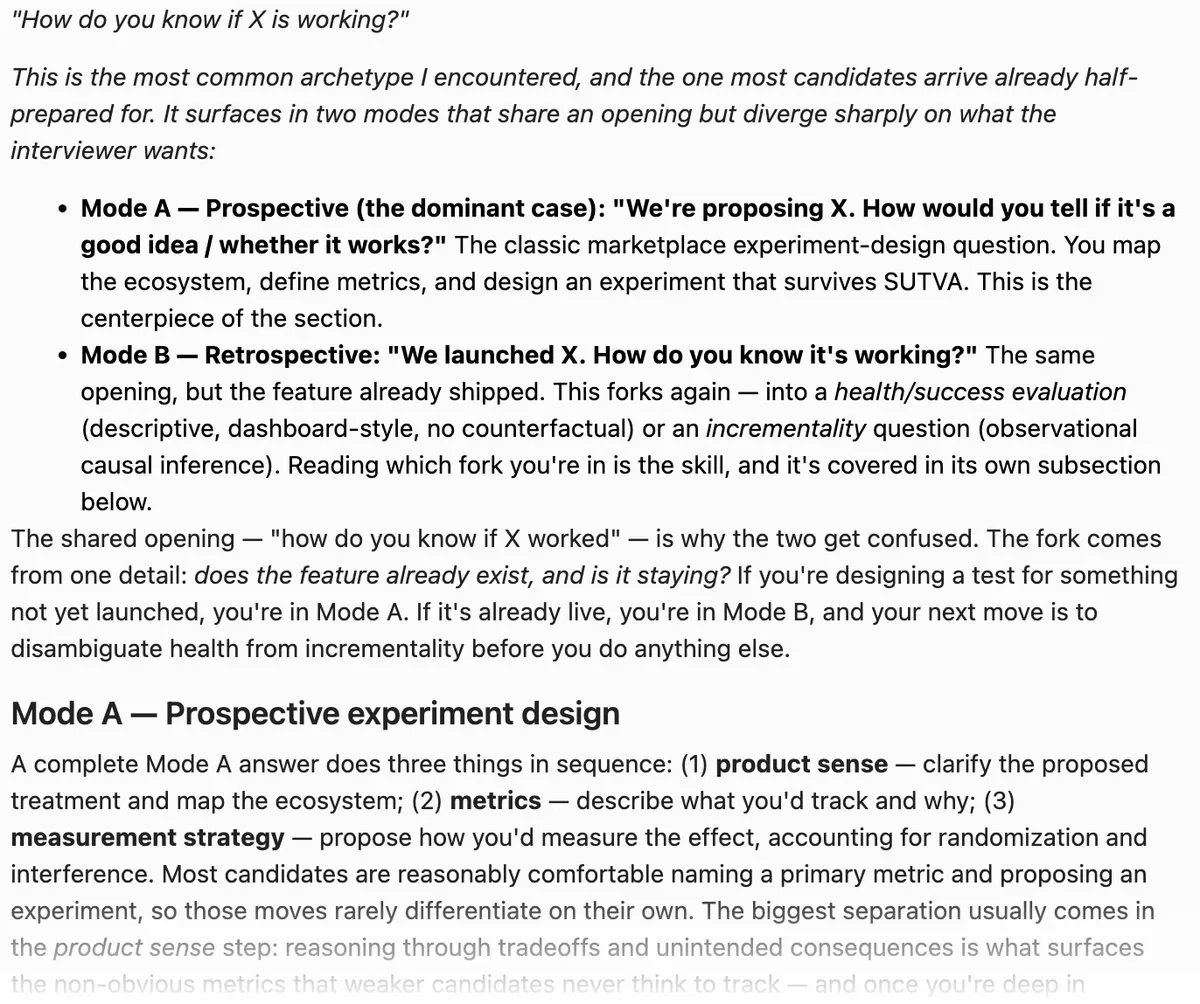
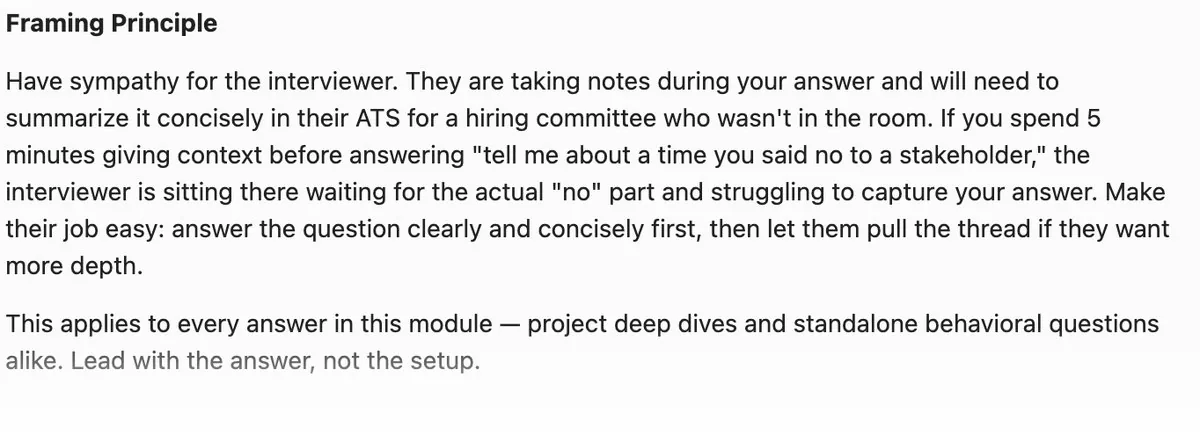
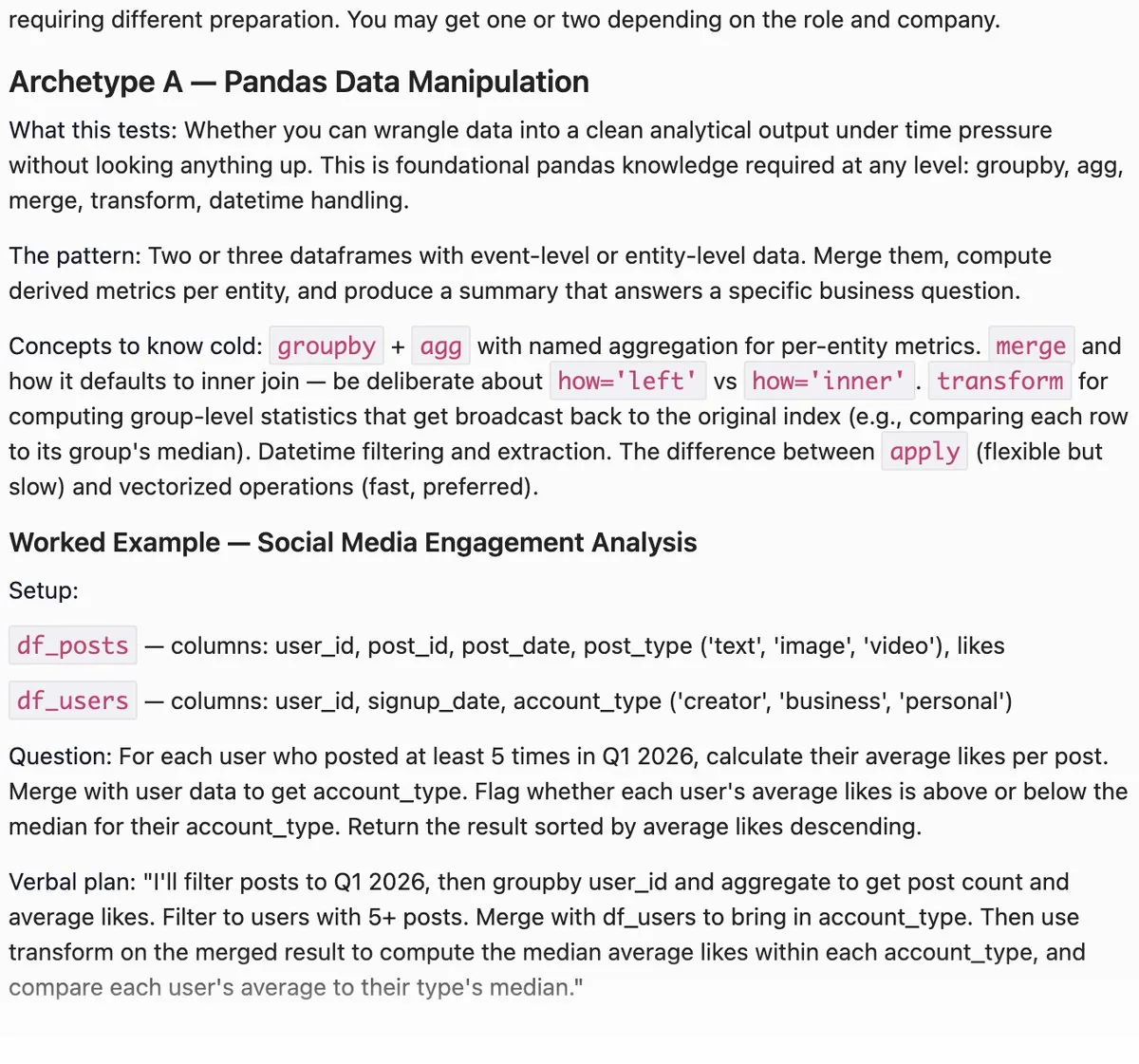
The Playbook itself is written rather than filmed, and it is specific. The exception is Master the Case Study, a standalone chapter of 80 minutes of video. Below are unedited excerpts from the written material, three from the modules people ask about most, then a sample of the practice problems that close out each section.
Watch the first video before you buy
The opening video of Master the Case Study is open to everyone, no email required. It is the same material paying readers get, so watch it and decide whether the rest is worth your money.
Recorded before the 2026 interview season, so the offers it names are the earlier ones. This is the framework I then took into 80+ rounds that Spring and converted five of eight final rounds with.
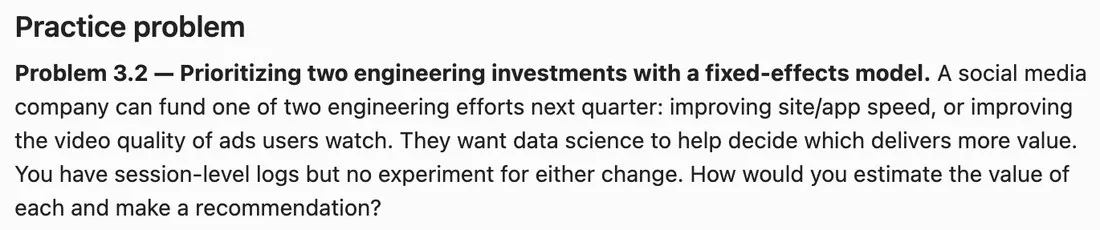
Practice problems throughout
Every section ends with problems built from questions I was actually asked, so you can work them before an interviewer does.


Who this is for
A good fit if
- You are getting final rounds and not converting them
- Mid-level, senior, or staff data scientist
- Case study rounds are the part you dread
- You interview at large US tech companies or want to
- You can code and evaluate an experiment already
Not a good fit if
- You are not getting interviews at all, which is a resume and networking problem that this will not fix
- You want a SQL or Python fundamentals course
- You want guaranteed questions from a specific company
- You are looking for a referral rather than preparation
If you are not getting the interviews, start here instead
This course will not help you get into the room, and I would rather say so. Getting interviews is a resume and networking problem, and I have two free things for that:
- The data science resume template I use myself, with a guide to writing it
- A LinkedIn outreach template, plus the referral loop that turns cold messages into warm introductions
Both are on the site in full. No email required.
Candidates often find themselves patching together fragmented blog posts, outdated practice problems, and scattered frameworks. It’s inefficient and incredibly frustrating. I was hand-curating learning guides for my clients and was contemplating writing a comprehensive guide myself. Thankfully, Jonathan just solved this problem.
Yes, it’s a premium resource. But considering it distills the hard-fought patterns of 80+ actual interview rounds into an actionable blueprint, the ROI is a no-brainer. Land just one strong offer, and this pays for itself on day one.
Shared publicly on LinkedIn. Unpaid and unaffiliated.
Jonathan’s interview playbook helped me tremendously in how I view the interview process and prepare for it. Personally, I got the most out of the course through three things:
- A thought framework with clear logic flow that starts simple and adds one layer at a time, building both depth and breadth into case study answers;
- A breakdown of what each interview round includes and how to prepare for it, including with AI;
- A list of requirements from junior to staff level, showing what to focus on based on your level and where to pivot to show depth during interviews.
I am truly grateful for Jonathan’s course as it helped me pass my very first final round and land my dream offer. If you’re looking to prepare thoroughly and feel confident going in, but aren’t sure whom to ask or where to start, this is a great investment.
The two formats and which one to book
Master the Case Study exists because the first mock interview I ran with a new client was almost always the same conversation: a full restructuring of how they worked through the problem, rather than anything specific to them. After correcting the same handful of errors enough times, I recorded it, which gave people more material than a single session at a lower price and in a form they could rewatch.
So if the case study is your only real gap and you have not been passing those rounds, that series on its own may be all you need. If you want the whole loop, the Playbook covers every round and includes the series anyway. A 1:1 session is worth it when you are genuinely stuck on where you are losing ground, or when a high-stakes round is coming up soon and you want to maximize your chances at that specific company.
The Data Science Interview Playbook
Every round, end to end. Written, roughly 120 pages of material, including the full 80-minute Master the Case Study video series as a standalone chapter.
or payment plans from $167/month
Get the PlaybookMaster the Case Study
80 minutes of video across 6 parts on Archetype 1, the “we want to launch this feature, how do we know if it’s a good idea” format. The most common case you will see. Already included as a standalone chapter of the Playbook, so only buy this separately if you want the case study material on its own.
The price reflects senior roles in US tech. I have worked with people in Brazil, India, Malaysia, Poland, Germany, and the UK, as well as new graduates applying for junior roles in the US, and I keep codes for markets where $499 is not a reasonable number. If price is the only thing stopping you, get in touch.
Before you buy
Is this useful if I’m a junior candidate?
Yes, and junior candidates do buy it. The material is pitched at the senior and staff bar, so some of it is above where you will be evaluated. Knowing where that bar sits is useful, and the case study and behavioral material applies at any level. The price is set for senior candidates in US tech, and junior roles are one of the cases I keep codes for, so say so if that is the barrier.
I’m not in the US. Is the pricing negotiable?
Yes. I have worked with people in Brazil, India, Malaysia, Poland, Germany, and the UK, and I have discount codes for markets where $499 is not a reasonable number. Tell me where you are and I will send a code.
Does the Playbook include Master the Case Study?
Yes. All 80 minutes of it sit as a standalone chapter inside the Playbook, so it arrives automatically, with no coupon to request, nothing to claim, and no second enrollment. If you bought Master the Case Study on its own earlier and want to move up to the Playbook, get in touch.
How is the course delivered?
It is written rather than filmed, roughly 120 pages of material, hosted on Teachable with lifetime access. That is deliberate: it is faster to skim, easy to search the night before a round, and simple for me to keep current when interview formats shift.
The one exception is Master the Case Study, which is 80 minutes of video across 6 parts and sits inside the Playbook as a standalone chapter. The opening video of that series is free to watch without buying anything.
How current is this material?
The core of it comes from the interviews I ran in April and May 2026, written up immediately after each round. The AI-assisted coding round content in particular reflects a format that only appeared in May 2026. Interview processes do drift, so I would rather you use this while it is fresh.
Should I buy this or book 1:1 coaching?
Start with the course. It covers far more ground than a single session can, and it costs less than most people expect to spend on prep. Coaching is worth adding when you want live pressure and specific feedback on how you answer, though my availability is genuinely limited since I work full time.
Can I get a refund?
No. The whole Playbook is readable in a day, so refunds after purchase are not something I can offer. That is why there is a free preview lecture and a detailed breakdown of every module on this page: I would rather you know exactly what you are buying than find out afterwards. If something in the material is broken or inaccessible, tell me and I will fix it.
You are already getting the interviews
The gap between a final round that ends in an offer and one that does not is usually not knowledge. It is how the answer is built. That is a learnable thing, and this is the fastest version of what it took me eighty rounds to work out.